Sunday, August 4, 2013

The Extreme Music Forum's Top Recommended Metal Albums

A few weeks ago, I undertook a project. After finding the TalkClassical Forum's Top Recommended Lists extremely helpful in my exploration of classical music, I sought to bring a similar set of lists to the metal community. I chose the Extreme Music Forum on last.fm as a place from which to collect votes, as I found this group to be a happy medium between having a decent number of active members and having a member base that is relatively well-educated in regards to the metal canon.

Members were asked to list their favorite metal albums in various genres, up to 30 albums per genre. Points were then given to releases based on their ranking in each list. For instance, each #1 pick received 30 points, each #2 pick received 29 points, and so on. Points were then manually counted, and albums were ranked according to these points. Based on these rankings, a master list is created in the vein of the classical music lists linked above.

Some observations from the project:

  • 213 death metal releases, 203 heavy metal releases, and 154 black metal releases were submitted as favorites. In a sense, this hints at an impressive catalogue for metal.
  • Both death metal and black metal boasted a #1 frontrunner with a significant lead over the rest of the albums in terms of points. While other variables are at play (Mayhem or Jag Panzer having only one major acclaimed full-length album each versus several from Darkthrone or Iron Maiden, for instance), this shows that each genre has major milestones of historical significance. 
  • Black metal had notably fewer artists listed amongst the top ranked bands, demonstrating that black metal history has generally been defined by a small elite, particularly that of Scandinavia, in contrast to a wide variety of death metal bands.

Without further ado, here are the top recommended lists completed thus far:

Top 25 Recommended Heavy Metal Albums: 

1. Jag Panzer - Ample Destruction
2. Mercyful Fate - Don't Break The Oath
3. Judas Priest - Sad Wings Of Destiny
4. Cirith Ungol - King Of The Dead
5. Manilla Road - Crystal Logic
6. Black Sabbath - Master Of Reality
7. Black Sabbath - Vol. 4
8. Fates Warning - Awaken The Guardian
9. Mercyful Fate - Melissa
10. Riot - Thundersteel
11. Judas Priest - Stained Class
12. Satan - Court In The Act
13. Fates Warning - The Spectre Within
14. Angel Witch - Angel Witch
15. Omen - Battle Cry
16. Helstar - Nosferatu
17. Diamond Head - Lightning To The Nations
18. Mercyful Fate - Mercyful Fate
19. Black Sabbath - Paranoid
20. King Diamond - Abigail
21. Cloven Hoof - A Sultan's Ransom
22. Black Sabbath - Black Sabbath
23. Pagan Altar - Mythical & Magical
24. Brocas Helm - Black Death
25. Adramelch - Irae Melanox

-------------------------------------------------------------
Top 25 Recommended Death Metal Albums: 

1. Morbid Angel - Altars Of Madness
2. Demilich - Nespithe
3. Incantation - Onward To Golgotha
4. Dismember - Like An Everflowing Stream
5. Demigod - Slumber Of Sullen Eyes
6. Possessed - Seven Churches
7. Immolation - Close To A World Below
8. Incantation - Mortal Throne Of Nazarene
9. Deicide - Legion
10. Gorguts - Obscura
11. Disembowelment - Transcendence Into The Peripheral
12. Immolation - Here In After
13. At The Gates - The Red In The Sky Is Ours
14. Septic Flesh - Mystic Places Of Dawn
15. Autopsy - Mental Funeral 
16. Morbid Angel - Blessed Are The Sick
17. Atheist - Unquestionable Presence
18. Massacra - Final Holocaust
19. Autopsy - Severed Survival
20. Lykathea Aflame - Elvenefris
21. Necrophobic - The Nocturnal Silence
22. Bolt Thrower - Realm Of Chaos
23. Entombed - Clandestine
24. Molested - Blod-Draum
25. Dead Congregation - Graves Of The Archangels

-------------------------------------------------------------
Top 25 Recommended Black Metal Albums: 

1. Mayhem - De Mysteriis Dom Sathanas
2. Darkthrone - Under A Funeral Moon
3. Blasphemy - Fallen Angel Of Doom
4. Master's Hammer - Ritual
5. Darkthrone - A Blaze In The Northern Sky
6. Bathory - Under The Sign Of The Black Mark
7. Rotting Christ - Thy Mighty Contract
8. Bathory - Blood Fire Death
9. Sacramentum - Far Away From The Sun
10. Burzum - Hvis Lyset Tar Oss
11. Emperor - In The Nightside Eclipse
12. Immortal - Pure Holocaust
13. Beherit - Drawing Down The Moon
14. Darkthrone - Transilvanian Hunger
15. Sarcofago - INRI
16. Bathory - The Return......
17. Darkthrone - Panzerfaust
18. Celtic Frost - Morbid Tales
19. Enslaved - Vikingligr Veldi
20. Gorgoroth - Antichrist
21. Dissection - The Somberlain
22. Gorgoroth - Pentagram
23. Mortuary Drape - All The Witches Dance
24. Burzum - Det Som En Gang Var
25. Celtic Frost - To Mega Therion

Wednesday, July 24, 2013

Repetition In Music Or Lack Thereof: On Themes And Recapitulations

In classical music, listeners tend to identify most with strong "main themes" or significant melodies. The fame of Beethoven's symphonies tends to result from its highly memorable themes, for instance, as opposed to its structural genius or overall character; Beethoven's 9th would have far less significance to our fickle modern culture without the monumental theme of the "Ode to Joy" while Beethoven's 5th symphony is almost entirely characterized by casual listeners by it's famed "motive X."

A favorite piece of mine throughout this last week has been Felix Mendelssohn's violin concerto in E minor. However, this piece has not been without its frustrations. The first movement opens with what I consider to be the most magnificent melody that Mendelssohn ever wrote, and quickly evolves into a grand portrayal of that theme that stands alongside the grand themes of the first movements of Beethoven's 7th, Brahms' 4th, or Liszt's Faust Symphony. However, the problem arises for the casual listener when this theme literally never returns in such grandiose form. Its rhythmic pattern is utilized throughout the movement as a vessel for new melodies, just as Beethoven utilizes "motive X" in different melodic forms throughout the 5th symphony, and its melodic form even returns nine minutes into the concerto, but only in a subdued, almost taunting manner. This leaves the attentive listener craving the initial moments of the concerto, but, ultimately, after repeated listens, seeking out scraps of personal meaning and appreciation in the seemingly insignificant recapitulations of the theme.

While at first I boldly claimed to Matt that not allowing the theme to return in fullest form was a mistake on Mendelssohn's part, repeated listens have taught me otherwise. After all, perhaps Mendelssohn intended to taunt listeners, and he certainly did so successfully, as I have been returning to this concerto more than any other classical piece this week, not only yearning for the significant theme but also craving more from the concerto. As a result of further listening, as usual, I have ultimately gotten more from Mendelssohn's work, and perhaps this would not have been the case had Mendelssohn put the theme on display in a heavily repeated manner as one might expect from a Mozart symphony.

In contrast to Mendelssohn's violin concerto, we have the work of the modern ambient artist The Caretaker, particularly his most recent output which utilizes the heavy repetition of samples from Schubert's legendary Winterreise. The Caretaker processes these samples through various effects to create a sublime atmosphere. Whereas some artists choose to follow Mendelssohn's path, he actually takes significant themes, sometimes even fragments of singular themes, and composes entire songs solely using the repetition of these themes, thus capitalizing on the average listener's addiction to significant themes. There is no development, only a singular memorable theme in each song, and yet I must say that this equally unorthodox style works just as well as that of Mendelssohn.

Together the works of The Caretaker alongside Mendelssohn's violin concerto have taught me that music can gain value from straying from the standard of cyclical songwriting which relies on the re-use of themes in moderation. Now if listeners can apply these standards of expectation to grandiose yet unorthodox works like those of Gustav Mahler and Anton Bruckner, perhaps these listeners are in for a real treat.

Tuesday, May 21, 2013

Recommendations In Latin American Metal

As I delve further into the various metal scenes of Latin America, primarily those of Mexico and Brazil, I am more and more convinced that members of these scenes are more in touch with the most ancient spirit of extreme metal than bands from just about any other country. As much as the Swedes expanded upon metal's melodic nature or as much as the New York death metal scene delved deeper than ever into the depths of darkness, Latin American bands seem to consistently capture the vibes of old Morbid Angel, Possessed, Bathory, or Blasphemy more than any other. Specifically in the field of death metal, the Latin American scene seems devoted to taking the work of Slayer and Morbid Angel and expanding upon its vicious, unrelenting nature. However, the black metal scene is not to be ignored in these countries either. Here are some recommendations for those wishing to delve into the rich metal scenes of Latin America (in order of preference):

Timeless classics:
Sepultura - Morbid Visions
Sarcofago - I.N.R.I.

Primary Recommendations:
The Chasm - Deathcult For Eternity: The Triumph
Inquisition - Into The Infernal Regions Of The Ancient Cult
Cenotaph - The Gloomy Reflection Of Our Hidden Sorrows
Shub Niggurath - The Kinglike Celebration (Final Aeon On Earth)
Xibalba - Ah Dzam Poop Ek
Mortuary - Blackened Images
Avzhia - Dark Emperors
Mystifier - Goetia
Mortem - The Devil Speaks In Tongues

Secondary Recommendations:
Hades Archer - For The Diabolical Ages
Vulcano - Bloody Vengeance
Hacavitz - Venganza
Wrathprayer - The Sun Of Moloch: The Sublimation Of Sulphur's Essence Which Spawned Death And Life
Pentagram - Pentagram

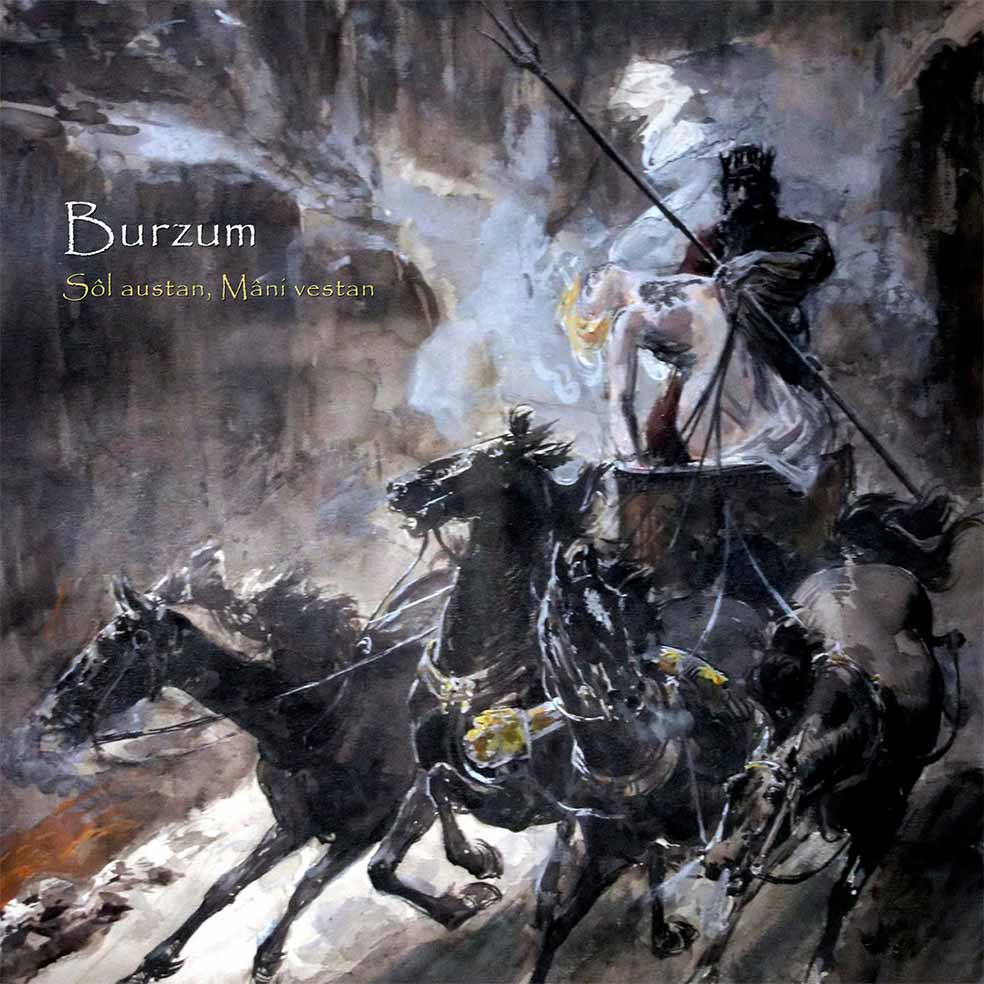
2013 Albums: Burzum - Sôl Austan, Mâni Vestan


On first listen, this album is merely a full work drawn from the melancholic sections of Varg Vikernes' prison albums and is generally receiving highly negative reviews by those metal fans that find it to be uninspired or not engaging. I will admit that the mood and even the compositional techniques rarely vary in this work; however, after further listening, its lack of variety is more due to its narrative structure, acting more as one long song than as a varied work along the lines of Burzum's finest metal works such as the legendary magnum opus Hvis Lyset Tar Oss. The real question regarding this album's value lies in the listener's understanding of ambient music: does an ambient album have to engage in a variety of techniques from start to finish or be as musically engaging as more active forms of music to be considered legitimate art? I would answer with a resounding "no" and expound upon this answer with the notion that some ambient music must simply sound pleasant as background music to achieve its goals. The chief example of this idea is Erik Satie and his "furniture music" - not meant to be listened to with full attention so much as appreciated for the atmosphere it evokes. Am I comparing Varg's late compositional quality to Satie's? No, but I still find this album pleasant to listen to in an ambient context, and that fact places it far above his other post-prison albums in my preference, albums which try and fail to engage the listener in that more active form of musical experience. As for the lack of variety, several great metal albums have achieved underground fame through a similar vibe of sounding like "one long song" - examples include debuts from Incantation and Sepultura.

In summary, if you're looking for an active listening experience full of varied compositional techniques and engaging hooks, this album is not for you; however, given Varg's inability to continue to write competent metal music, I am personally glad he has changed direction and is at least able to provide this soothing piece to ambient fans.

Wednesday, March 6, 2013

Glenn Gould on "vacuum cleaner music"

Mike Springer from openculture.com posted a very interesting interview with Gould from 1969, in which he discusses the future of musical reproduction and his experiments in counterpoint with household appliances, instruments and human voice.

The recent Gould re-releases on Sony include expanded recordings of some of his greatest and most original work, including Piano Concertos Nos. 1-5 & 7 (BWV 1052-1056 & 1058) with Leonard Bernstein and Vladimir Golschmann conducting the Columbia Symphony Orchestra.

Wednesday, February 27, 2013

Under One Banner: On National And Regional Trends As The Inherent Link Between Music - Part I: Passion, Extremism, And German Music


The question all started with Germany. The Germans are well known in nearly every realm of music for producing innovative, quality works. Bach and Beethoven, both Germans, were arguably the two most important figures in classical music. Kraftwerk and Tangerine Dream allowed electronic textures to expand until rock influences were abandoned for the creation of an entirely new genre. German progressive rockers like Can and Faust were distinctive enough to be tagged with the label "krautrock" instead of being lumped in with the rest of the world's progressive rock scene. Even the German metal scene, most famous for the Teutonic Trio of Kreator, Sodom, and Destruction, is known worldwide by metal fans. When asked about the nature of the German metal scene, I noted that, although the German sound is not as distinctive and easy to pin down as the sounds of Finnish death metal, Norwegian black metal, or British heavy metal, there is an underlying theme of severity, extremism, or even hatred in German metal. Some notable examples:


While the inherent link between German metal artists may be apparent to the discerning listener, I had a harder time linking the German metal scene to other German music. Where is the link between this severity and the works of Johann Sebastian Bach or Tangerine Dream? During our discussion, Matt provided a possible answer to this question. Germany has a rich tradition of deep pride in its art, innovations, and national history, as is apparent throughout history, far before the rise of the obviously controversial National Socialist movement. Throughout the history of art, science, and philosophy, Germans have demonstrated a tendency to lend passion and extremity to their work, ranging from the earth-shattering ideas of Einstein and Planck to the unfathomably bold statements of Nietzsche to Bach's musical quest for the portrayal of God himself. 

This passionate extremism in art acts as the common link between most notable German music, tying together the seemingly alien genres of classical, electronic, rock, metal, and others with a common goal. Starting with classical music, German music immediately set itself apart from medieval music by applying a grandiose nature to the music on a monolithic scale. While Bach and Beethoven, the two prime examples familiar to laymen, differed drastically in their musical tendencies and goals, both embody the unbound ambition of German art. 


Bach’s lush cantatas, sobering masses, and regal organ works sought to make God’s presence on the human plane tangible. While the cynicism of German philosophy or the hatred of German extreme metal may seem to be stark contrasts to Bach’s work, they all bear one crucial similarity: ambitions of an epic nature that break free of human limitations and seek to reach the extremes of the universe. While Beethoven's works tended to incite more of a human connection than Bach's sacred music, his work, especially his symphonies and overtures, also captured a previously unheard of epic quality in pursuit of an ambitious ideal:


While it is relatively clear that the overtly severe extreme metal scene of Germany or the longstanding tradition of grandiose classical music demonstrate the Germans passion and ambition for the extreme, it may be less clear how the legendary electronic music movement of Germany relates to such ideals. The answer? Extreme minimalism.


While the grandiose nature of German classical may seem lost in these droning pieces, the ambition for extremism is still there, albeit in a more Nietzschen sense. As if acting as Beethoven's counterpart, these artists seek to create monolithic art out of extreme nothingness, out of a cold void. One only finds meaning in the works of Klaus Schulze by making note of subtle shifts in momentum and texture; appreciation for this extremely minimal music requires every bit as much focus as appreciation for the most vast of German symphonies.


Keep in mind, the point of this series is by no means to explore the significance of extremism, nationalism, or other facets of art and philosophy. I hope only to find inherent links within all music by finding the subtle similarities between the most seemingly different artists of our time that hail from under one banner.

Under One Banner: On National And Regional Trends As The Inherent Link Between Music - Introduction

The formulation of this idea in my head was actually one of the inspirations for starting a collaborative blog. One day, while Matt specialized in electronic music, and the majority of my focus was still within the realm of extreme metal, we discussed national scenes. After mentioning my intrigue at the stark similarities between artists within a single scene, Matt asked me if I saw similarities between artists from the same country but hailing from entirely different genres (metal, electronic, classical, etc.). After this conversation, I started looking for links between all music, hoping to unveil deeper musical trends and increase my own knowledge of music, and ultimately spawning the idea for a collaborative blog.

Of course, most music enthusiasts will admit right off the bat that differing lifestyles and regional settings well obviously influence music. But just how do these national trends manifest themselves in music? This series will serve as a first attempt to explore that question.